

December 4, 2025 1:52:22 PM
Share:
Success in the insurance industry requires more than strong sales skills. Agents who understand how to structure and manage their business—through purposeful budgeting, reinvestment, and operational planning—tend to experience more consistent growth and long-term stability. These are the same foundational principles used in high-performing sales organizations, and they apply just as directly to independent agents building their own practice.
Yet many agents are never introduced to these fundamentals. They’re taught how to sell, but not how to plan, budget, or create predictable systems that support sustained growth. As a result, production often fluctuates, income becomes unpredictable, and scaling the business feels out of reach.
A clear reinvestment strategy helps eliminate these challenges by providing structure around where agents should allocate revenue, how much to reinvest, and what operational decisions will support future production.
Why Reinvestment Matters: Insights from High-Performing Organizations
When you look across strong sales organizations and service-based businesses, a consistent pattern emerges: predictable growth comes from intentional reinvestment.
Industry research and benchmarking across small business, financial advisory, and sales-driven environments show several themes:
Growing service businesses commonly reinvest a meaningful share of their revenue into marketing, operational capacity, and staffing.
Within the financial advisory space, firms that maintain structured annual reinvestment—especially toward client acquisition and support—tend to scale more steadily.
High-performing sales teams emphasize consistent pipeline development and allocate fixed budgets for lead generation, infrastructure, and system improvements.
These same concepts apply directly to insurance. Independent agents who approach their practice with a similar business framework often experience more stable pipelines, better persistency, and stronger year-over-year performance.
How Much Should Insurance Agents Reinvest? The Recommended Range
Across the industry, a practical reinvestment target for insurance professionals is:
25–35% of gross commissions each year.
This range supports reliable lead flow, allows for system upgrades as production grows, and provides the resources needed to operate at a professional level.
A typical allocation might look like this:
1. Leads & Marketing (20–30%)
Lead flow is the foundation of predictable production.
Agents working toward year-over-year growth often allocate a defined portion of revenue to:
Direct mail
Telesales leads
Digital leads
Appointment-setting services
Branding and outreach initiatives
Industry benchmarking shows a clear trend: allocating 10–15% of revenue generally supports maintenance-level business, while 20–30% supports more robust growth. Telesales agents generally invest toward the higher end, while field and hybrid agents may operate effectively at slightly lower percentages depending on referral activity.
2. Technology & Systems (3–7%)
As insurance operations evolve, technology plays an increasingly important role.
Agents typically invest in:
CRM platforms
Dialers
Task automation
Document management systems
Research across the sales and service sector consistently shows that organizations using structured systems and technology see stronger follow-through, improved efficiency, and better client management. For agents, these tools expand capacity and directly support higher production.
3. Administrative Support & Staffing (5–15%)
As production grows, administrative responsibilities follow.
Delegating non-selling tasks is a well-established driver of increased revenue capacity. Analyses across sales organizations and professional services highlight that professionals who offload administrative work can redirect significant time back into revenue-generating activities.
Agents generally begin with part-time support—often a virtual assistant—and expand to additional help as their policy count and production scale.
4. Continuing Education & Professional Development (2–5%)
Ongoing learning is a hallmark of top-performing advisors and agents across many financial fields. Investment in this area may include:
Sales training
Product education
Business development coaching
Industry conferences
Advisory and sales studies consistently show that professionals who prioritize structured education tend to see improved client outcomes, higher retention, and greater long-term growth.
5. Chargeback Protection & Cash Reserves (5–10%)
Maintaining financial reserves is a critical part of operating a healthy business.
Setting aside a portion of commissions helps protect against typical chargeback exposure and creates stability during fluctuations in persistency, market conditions, or seasonality.
How Reinvestment Supports Growth
When evaluating growth patterns across sales-driven industries, a clear relationship emerges between reinvestment and annual growth:
Agents who reinvest around 30% typically experience 20–40% annual growth.
Agents who reinvest less than 10% often see flat or declining production.
The structure—not the intensity—of investment is what creates predictability. When an agent commits to consistent budgeting, the business becomes less reactive and more measurable.
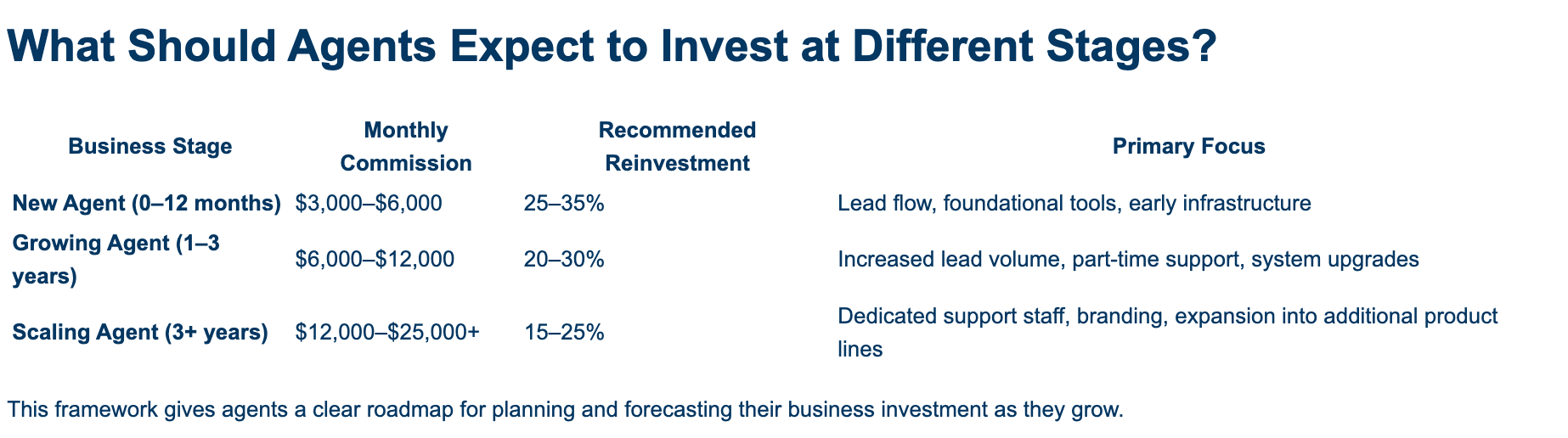
Putting the Framework Into Action
Agents who achieve consistent year-over-year growth typically share several operational habits:
Establish predictable lead flow
Use technology to streamline and automate recurring tasks
Delegate administrative work to free up selling capacity
Reinvest consistently rather than reactively
Track key performance metrics such as closing rates, cost per lead, persistency, and revenue per policy
These practices mirror the operational discipline seen across high-performing organizations and translate effectively to independent insurance practices.
How Final Expense Brokerage Supports Growth-Focused Agents
Final Expense Brokerage is committed to helping agents build not just production, but a sustainable business. Our team supports agents by:
Paying for 10-25% of your total lead costs
Guiding cost-effective lead strategies
Helping establish predictable sales pipelines
Providing insight on contract selection and underwriting niches
Offering case guidance and operational support
Reducing unnecessary expenses by removing quoting tool costs and allowing agents to direct more of their budget toward lead generation
Whether you're launching your career or expanding a growing practice, having a clear business structure is what helps turn effort into lasting momentum.